
How Intelligent People Lie to Themselves
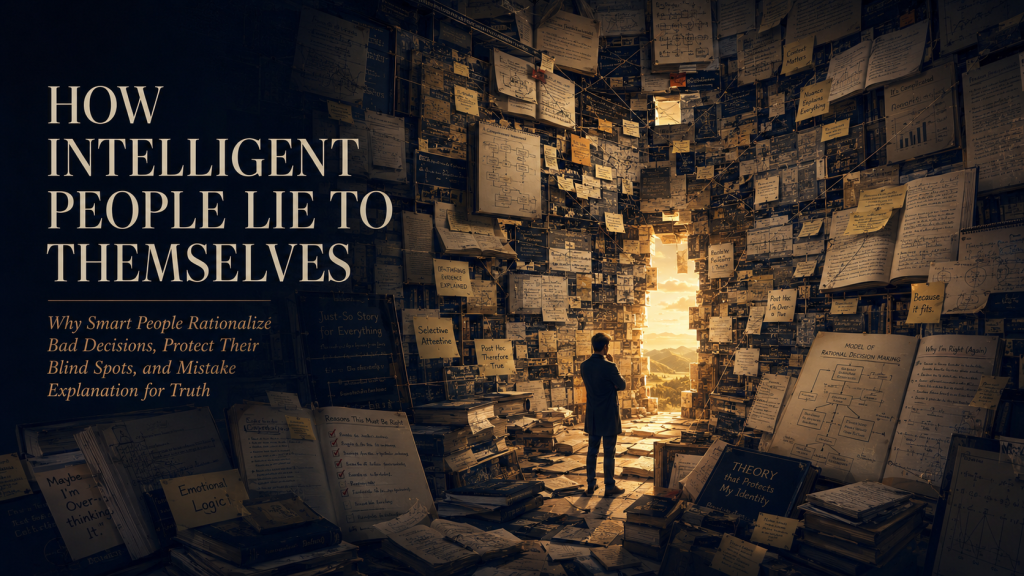
Why Smart People Rationalize Bad Decisions, Protect Their Blind Spots, and Mistake Explanation for Truth
He had been explaining his job for three years.
Not complaining about it — explaining it. There is a difference, and the difference matters. He would sit across from you at dinner and walk you through, with real precision, the reasons why leaving now would be foolish. The economy. The timing. The project they were about to finish. The role he’d been promised. The manager who was difficult but not impossible. The mortgage. The industry in transition. The resume gap. His age. His specialty. The fact that his skills, if he’s honest, were somewhat particular to this organization, and starting over somewhere new would mean — well, he’d lose a decade. And he wasn’t getting younger.
He was not stupid. He was, if anything, the opposite. He had read widely. He thought carefully. He could anticipate counterarguments before you made them. And when you listened closely, you realized that each of his reasons was technically true. The project really was almost done. The manager really was difficult. The mortgage really did exist.
What he could not see — or would not — was that he had been “about to finish” that project for two years. That the promised role had never appeared in writing. That people younger and less qualified had left the same organization and found, without incident, better things. What he could not see was that his intelligence was not helping him evaluate the situation. His intelligence was helping him describe it.
This is the thing we rarely say about smart people. We worry they’ll be arrogant, or cold, or disconnected. We rarely worry about this: that the same capacity that lets them understand complex systems, analyze institutions, and think three moves ahead — that same capacity can be turned, with extraordinary efficiency, against themselves. Against the truth.
Intelligence as a Defense Lawyer
There is a version of intelligence that functions like a judge. Dispassionate. Evidence-collecting. Willing to be changed by what it finds. This is the version we celebrate in science and courts and good leadership. We speak of it reverently. She really thinks things through. He updates his views. They follow the argument wherever it leads.
Then there is the other kind, which is far more common and rarely named. This intelligence functions not like a judge but like a defense attorney. And the crucial thing about a defense attorney is that they do not begin with a question. They begin with a conclusion. The conclusion is that their client is innocent, or at least that a reasonable doubt exists, or at the very least that the prosecution has not made its case beyond challenge. The argument comes after. The evidence is sorted retroactively. What confirms the conclusion is elevated; what threatens it is scrutinized for weaknesses, discredited, set aside.
This is not stupidity. This is, in fact, the most sophisticated version of motivated reasoning: it doesn’t look like bias. It looks like careful thinking. It produces footnotes. It produces nuance. It produces the calm, measured tone of someone who has considered the alternatives and found them wanting.
The psychologist Jonathan Haidt called this “the rationalist delusion” — the idea that humans reason their way to beliefs, when in fact we mostly feel our way to beliefs and then reason backward to defend them. But Haidt’s framework, useful as it is, doesn’t fully account for what intelligence adds to this process. It doesn’t account for how much more convincing the defense becomes when the attorney is good at their job.
A low-intelligence person who lies to themselves creates a story with holes. The story doesn’t quite cohere. The timelines don’t add up. The excuses contradict one another. Even they can sometimes feel the looseness of it, the wobble.
A high-intelligence person who lies to themselves creates something more dangerous: a story with very few holes. A story that survives scrutiny because it is built to survive scrutiny. A story sophisticated enough to endure contact with reality — and in some cases, to emerge from that contact looking stronger.
The conclusion always came first. You just can’t tell anymore.
How Smart People Rationalize Their Decisions
What does this look like in an actual life?
It looks like the executive who spent three years insisting that his company’s declining numbers were a market problem, not an execution problem, while privately he was less certain than he appeared. His intelligence allowed him to track the right metrics, yes — but it also allowed him to select which metrics to track. There is a version of strategic sophistication that is indistinguishable from motivated analysis. He retired before finding out which version his had been.
It looks like the relationship that continues past the point any outside observer would have ended it, sustained not by delusion but by explanation. People in difficult relationships, if they are intelligent, can always explain the difficulty. The history. The complexity. The other person’s wounds. Their own growth. The way things were before. The way things might yet be. The explanation is not wrong, exactly. But it is also not quite honest.
It looks like the writer who does not write. She talks about the book constantly — at dinner, in interviews, in her mind before falling asleep. She has reasons. Good ones. The day job is real. The exhaustion is real. The fear that the book won’t be good enough — well, she doesn’t say that part, not in those words, but it’s in there, folded into the other explanations, invisible because it’s wedged between more respectable concerns.
This is what intelligence does with ambition: it provides context. Context for why not yet. Context for why the conditions aren’t right. Context that is true, mostly, but is doing something other than simply reporting on reality.
The smartest person in the room often has access to the best excuses. This is not because they are dishonest people. It is because the brain constructs justifications at roughly the same speed and quality as it constructs arguments, and high-functioning brains do both rapidly and well.
Why Facts Rarely Change Us
There is a common faith, shared by educators and journalists and most people who’ve spent time thinking about the information problem, that facts should move people. That if you present the right evidence in the right way, minds will shift. That the reason people believe wrong things is that they haven’t been properly exposed to correct ones.
This faith is largely wrong, and the mistake runs deeper than we usually admit.
Facts rarely change us when the facts require us to become someone else.
This is the actual issue. Not information. Not evidence. Implication. A fact is never simply a fact. A fact is always a fact in relation to an identity, a status, a set of commitments, a story we are living inside of. When the fact poses a threat not merely to a belief but to the person who holds that belief — when accepting the fact would mean conceding that we have been wrong about something we staked ourselves on, that the years we spent were wasted, that the person we thought we were is not who we are — the fact does not land as information. It lands as a threat.
And we respond to threats with the tools available to us. For people of ordinary intelligence, those tools are simple: denial, distraction, outrage. For people of considerable intelligence, the tools are more refined. They can entertain a fact while subtly altering its meaning. They can accept a study while noting its limitations. They can hold two contradictory beliefs simultaneously and call it nuance. They can be moved by evidence of their own wrongness and still, somehow, end up exactly where they started.
Francis Galton, who in the nineteenth century pioneered the study of intelligence and invented much of the statistical scaffolding we still use to measure it, was himself a devoted eugenicist who spent the second half of his life deploying his considerable intellectual gifts in defense of a belief system he had formed in early adulthood. He did not, despite decades of evidence and the protests of contemporaries far more humane, substantially revise his views. He refined them. He contextualized them. He added caveats. But he ended where he began.
The story was already written. His mind was very good at polishing it.
The Internet Era of Self-Deception
We are now, most of us, living inside a machine specifically designed to confirm whatever we already think.
This should alarm us more than it does. We speak of algorithmic bubbles and echo chambers as though they are primarily a political problem — as though the main danger is that people become polarized, that our collective reasoning degrades. This is true. But there is a subtler and more intimate version of the same problem, one that touches intelligent people in particular.
In previous centuries, self-deception required a certain amount of ambient ignorance. You could tell yourself a story about your health, your relationships, your choices, because there simply wasn’t that much information available to contradict you. Your doctor saw you once a year. You had one newspaper, maybe two. Your social world was legible and small. The stories you told yourself operated in a low-information environment.
Now we are all immersed in an extraordinarily high-information environment — and yet something strange has happened. We are not less certain. We are more certain. Not because we have found the truth, but because we have found support for whatever truth we needed.
Previous generations needed ignorance to deceive themselves. We need only a search bar.
Ask an AI to explain why your business idea is sound, and it will explain why your business idea is sound. Search for confirmation that your diet is optimal, and the search results will confirm that your diet is optimal. Follow the right podcasters, the right newsletters, the right accounts, and you will find yourself inside a curated universe that keeps telling you, with great sophistication and varying degrees of evidence, that what you already believe is correct.
The problem is not stupidity. The problem is that intelligent people are especially good at using these tools. They know how to search. They know how to evaluate sources, or at least how to appear to evaluate sources. They can construct a reading list that looks rigorous and functions as a mirror. They can engage with “both sides” in a way that consistently finds one side more compelling — the one they needed to find more compelling before the exercise began.
We no longer struggle to find information. We struggle to resist personalized justification.
Why Successful People Become Blind to Their Own Mistakes
Here is an idea that makes people uncomfortable: success is often the enemy of self-knowledge.
Not always. Not inevitably. But more often than we like to admit, the people who have been right before — who have made the call, backed the project, trusted the instinct, and been vindicated — develop something subtle and dangerous. They develop a case file. And the case file shows, with historical weight behind it, that their judgment is good.
It is good. That’s the problem. It really was good. The success is real.
But the brain does something with that success. It files it not as “I was right in that situation” but as “my sense of things can be trusted.” And from that point forward, the feeling of certainty becomes its own kind of evidence. The confidence that once was earned starts to operate like a credential that can be applied universally — to different domains, different decisions, different risks.
Success often creates blind spots precisely because it once created clarity.
This is why very capable executives destroy the companies that once thrived under their leadership. This is why artists who produced extraordinary early work become guarded and defended in middle age. This is why founders who built something remarkable from intuition spend the next decade overriding the people they hired to tell them when their intuition is wrong.
The past victories become a story. The story becomes a shield. The shield has a particular quality: it looks, from the outside, like wisdom. And from the inside, it is indistinguishable from wisdom.
The Calendar Test
There is a simple, devastating diagnostic for self-deception.
Ask someone what matters most to them. Then look at their calendar.
The calendar doesn’t lie in the way that words lie. The calendar doesn’t have access to the narrative, the context, the explanation, the well-constructed case for why this particular month has been unusual. The calendar simply records where the hours went. And if you read it carefully, you will often find a precise and brutal map of someone’s actual values — which bear, sometimes, no resemblance to the values they profess.
The person who says that their family is their first priority but whose evenings are reliably consumed by email — the calendar knows. The person who speaks of their creative practice as the thing they would protect above all else but who has not touched it in seven weeks — the calendar knows. The person who describes a friendship as essential but who has quietly rescheduled three times and simply not rescheduled after the third — the calendar, and the friend, know.
This is not about guilt. It is about information. The calendar is offering information that the explanatory mind is working hard not to integrate. Because integrating it would require saying something difficult: that the life I am living and the life I say I am living have drifted apart. That the story I tell about my priorities is not the story my behavior tells.
Extend this beyond calendars. Look at attention. Look at the things that catch and hold the mind in the spaces between obligations. Look at what gets worried about at 2 a.m. Look at what gets returned to, over and over, with an almost gravitational pull.
Repetition is the most honest thing about us.
It has no incentive to impress anyone.
The Mirror Test
I should say something honest here, because the narrator who stands entirely outside this problem is doing something dishonest.
Looking back, some of the most intelligent explanations I have ever produced were attempts to avoid a decision I had already made. Not that job, not those specifics, but the structure of it: the careful accumulation of reasons that all happen to point in the direction of staying still. I have been sophisticated about it. I have framed stillness as discernment. I have called avoidance patience. I have spent considerable effort constructing the difference between wisdom and fear, and then filed myself reliably under wisdom.
It is not that I was entirely wrong. The explanations were often true. The timing really was sometimes bad. The reasons really did exist.
But there is a test — a different kind of mirror test — that I learned to apply eventually, and usually too late. If the same problem keeps appearing in different forms across different contexts across different years: the same difficulty beginning things, or the same pattern in relationships, or the same way that ambition keeps describing itself without moving — the question worth asking is not “how do I explain this situation?” The question is: “what story am I protecting by staying in this situation?”
Because the situation changes. The job changes. The relationship changes. The city changes. And yet the pattern remains, which is evidence that the pattern is not caused by the situation. The pattern is caused by something the situation is offering cover for.
The problem may not be bad luck. The problem may be the story protecting us from seeing ourselves clearly. And the smarter we are, the better the story, and the longer it holds.
The Hidden Cost of Intelligence
Here is the most dangerous idea in this essay, the one I have been circling.
The greatest risk of intelligence is not that it produces wrong conclusions. Wrong conclusions can be corrected. Facts can land. Evidence can accumulate until the story collapses.
The greatest risk of intelligence is that it produces right-looking conclusions. Stories sophisticated enough that corrective facts can’t find purchase. Narratives that have anticipated the objections and pre-answered them. Explanations that are technically accurate in every particular and yet somehow, in their totality, in the direction they point and the action they permit, are profoundly false.
The greatest danger of intelligence is not that it helps us lie. It helps us lie elegantly.
Intelligence is often mistaken for a searchlight.
In practice, it can become camouflage.
It does not always reveal the truth.
Sometimes it helps us blend into our own explanations so completely that we can no longer distinguish ourselves from the story.
There are people who remain stuck not because they lack answers but because they possess explanations. The explanation fills the space where discomfort would otherwise live, and discomfort, if allowed to remain, might eventually become a catalyst. But the explanation is more comfortable than discomfort and more convincing than silence, so the explanation stays, and the catalyst never comes, and the years continue.
I think of the philosophical concept of “galaxy-brained” reasoning — the phenomenon where a very smart person follows a chain of individually plausible steps to a conclusion that most ordinary observers would immediately recognize as wrong. The concept is usually applied to political extremism or corporate scandal. But it applies just as well to the private life. The executive who convinced himself the numbers were improving has galaxy-brained his way to self-destruction. So has the person in the relationship that has been described, with increasing literary precision, as “complicated” for half a decade.
A mediocre liar deceives other people. A brilliant liar deceives himself. And the most convincing lies are built from facts.
The Opposite of Self-Deception
The opposite of self-deception is not intelligence.
This seems like it should be obvious, but we keep behaving as though it isn’t. We keep imagining that the solution to motivated reasoning is more reasoning, more evidence, better arguments, clearer explanations. We keep imagining that the path out of the story is through the story — that if we can only think our way to the right analysis, the analysis will set us free.
Sometimes it does. But more often, the path out is not through the narrative at all. It is through the body, or the behavior, or the testimony of someone who loves you enough to tell you something you will not enjoy hearing. It is through the thing the calendar reveals when you finally look at it honestly. It is through the pattern you finally allow yourself to see as a pattern.
The opposite of self-deception is honesty. And honesty — real honesty, not the performed kind that still manages to protect the things that most need protecting — often requires surrendering explanations we have spent years constructing. Stories we have lived inside so long we cannot quite see them as stories anymore. Narratives that have become identical, in our experience of them, with reality itself.
This is painful in a specific way. Not the sharp pain of confrontation or failure, but the slow, deflating pain of recognizing that a very good story was still, finally, a story. That the intelligence we were so sure was helping us see clearly was, in this particular case, helping us see clearly only in the directions that were safe to look.
There is a man I know who spent years explaining why he hadn’t started the thing he talked about most.
He explained it beautifully. He understood the industry, the timing, the ecosystem, the capital requirements, the competitive landscape. He understood, he would tell you, the psychological dimensions of the hesitation — the fear of failure, the perfectionism, the way ambition can become paralyzing in inverse proportion to how seriously you take it. He had read the books. He had done the thinking.
One day he stopped explaining and started.
He doesn’t talk about it much now. He’s too busy. The thing is mediocre in places and good in others and not yet what he thought it would be, but it exists, which is a different kind of thing than being explained.
He still catches himself, sometimes. A new reason. A new framing. A new context that makes the next step seem slightly premature. When he notices it, he gets quiet for a moment and then does something anyway.
He is not smarter than he was.
He has simply become more suspicious of explanations that arrive too quickly.
Especially the elegant ones.
Especially the explanations that leave everything exactly as it is.
Because he has noticed something over the years.
The explanations that protect us are often the easiest to understand.
The truths that change us rarely arrive that way.