
The Last Thing We Are Defending
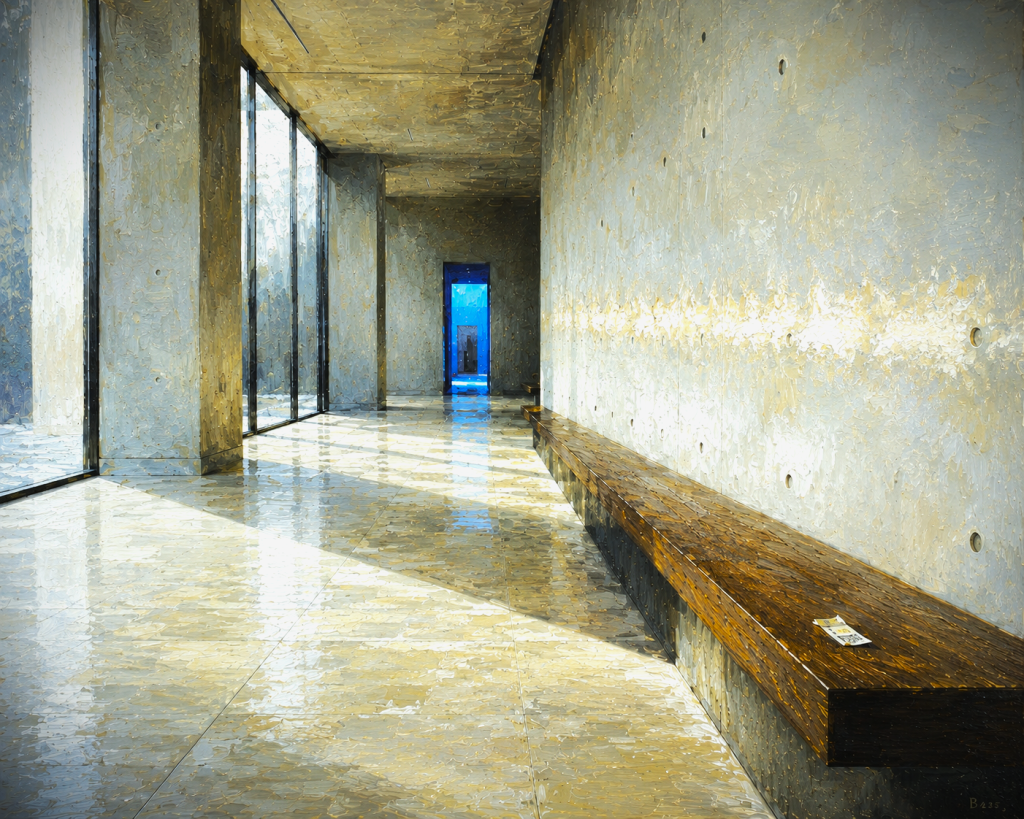
A woman in the Louvre had waited forty minutes for this. A line curling twice around a velvet rope, feet aching on marble, strangers pressing close on either side. Now she stood at the front, close enough to see the craquelure in the varnish, close enough that a guard would have to say something if she leaned any closer.
She did not raise her phone. A better camera than this was already sitting in her pocket, one that could pull detail from the canvas no eye alone could manage. She did not use it. She just looked. The room hummed with murmured languages and shuffling feet, and somewhere behind her a child asked his mother why they had waited so long for a small painting, and the mother did not answer him, because she did not have an answer either, only the waiting itself, only the wanting.
Eleven seconds, maybe. Then the guard behind her nudged the line forward, and she was walking again, already becoming part of the crowd she had just been standing apart from.
She did not look back at it. People rarely do. They carry the eleven seconds out through the gift shop, past the postcards that show the same face in better light than they had ever managed to see it in, and they buy one anyway.
Somewhere in that line, a teenager photographed the painting on a phone held above a hundred other phones, the image already smaller and flatter than the painting itself. He knew this while he took it. He took it anyway.
They had not come for the image. It was already everywhere, reproduced past the point of scarcity, hanging in dorm rooms and dentist’s offices and the sides of coffee mugs. They had come to stand where the paint had actually been touched by a hand, decades before any of them were born. A copy could carry the color, the composition, even the crack in the varnish, down to the pixel. Not that.
Elsewhere in the city, on a screen no one in that line would ever see, a machine had been asked for a painting in an old master’s style. Nine seconds later it delivered one, complete with the kind of imperfection that used to take a lifetime to earn.
Someone would look at it and say the sentence people have been saying since the first images learned to multiply themselves.
“That isn’t real art.”
Most of us have said some version of it.
A monk sits in a stone room. He presses a wooden block against paper, lifts it, and an image appears that would have taken him weeks with a brush and a steady hand. An older monk in the doorway watches him do this.
He says nothing kind.
Some years and some countries later, a man stands beside a river with a strange wooden box on a tripod. He points it at the water, waits, and the water’s exact likeness settles onto a silvered plate inside. Painters gather around the box with something between fascination and fury.
One of them says painting is dead.
A machine with a rotating cylinder catches a human voice in a room and plays it back later in an empty one. A newspaper column calls it a soulless trick.
Decades on, a computer renders a dinosaur that never lived and never breathed, and half the audience in a darkened theater insists you can somehow tell it isn’t real, though none of them can say how.
And now, a prompt typed into a box produces an image in less time than it takes to boil water.
Mechanical. Cheating. Soulless.
Follow one craft backward far enough and expertise does not disappear. It stops living where people last learned to look for it.
A scribe spent years learning to copy a page without error. A photographer could capture a face in a fraction of a second and still spend an hour deciding which photograph to print.
A novelist once proved mastery by drafting every sentence, first by hand, then by typewriter, then by keyboard. She may increasingly prove it by deciding which sentences are worth keeping.
A man keeps his father’s old wristwatch in a drawer, though it runs eleven minutes slow and cannot be fixed anymore, because the man who could fix it died years ago. He could buy a watch that keeps perfect time for the price of a sandwich. He keeps the broken one.
A child’s crayon drawing of a house, all wrong angles, a sun the size of the roof, gets taped to a refrigerator with more ceremony than a museum uses for its most famous canvas.
A forged painting can be pixel for pixel, brushstroke for brushstroke, chemically indistinguishable from the original. The moment a museum discovers the forgery, the painting does not become one atom less beautiful to look at. It becomes, in every way that matters, worthless.
People don’t trust effort because it is difficult. They trust it because it is difficult to fake.
In the old city of Fez, a calligrapher spends four years learning to hold a reed pen before his teacher trusts him with a single public verse. A machine could produce the same verse in less than a second. Four years later, he is still learning to hold the pen.
A Japanese woodworker apprentices for a decade under a master who, for the first two years, will not let him touch a chisel at all. He sweeps floors. He watches. He learns to want the tool before he is trusted with it. The wood does not change while he waits. He does.
A bowl thrown on a wheel by a craftsman in his sixties is not more useful than one stamped from a mold in a factory. It holds the same soup.
The bowl was never only for holding soup.
Forged paintings have deceived collectors and museums for decades, some discovered only after the forger’s death, some never discovered at all. Deepfakes have fabricated evidence for events that never happened. When thousands of images begin resembling one another, people slowly forget how many different ways there are to see. A hand forgets what it once knew how to do.
Somewhere, right now, someone is finishing a manuscript at eleven at night. She reads the last paragraph twice, closes her eyes, and presses submit. Then the waiting starts. She refreshes an inbox that has nothing new in it. She refreshes it again the next morning, and the morning after that, wondering whether the file was ever opened at all.
She imagines someone opening the file. She does not know that moment may never come. She knows only that the inbox stays empty. One day becomes three. Three become twelve.
Waiting is the only part she can see.
While she waits, the work has already moved on somewhere else. Film editors are cutting entire films on computers while audiences are still arguing that real editing happens on strips of film. Architects are designing buildings that will one day stand for a century from drawings that never exist on paper. By the time the argument reaches the front page, the profession has usually been living with the answer for years.
An illustrator who spent nine years learning anatomy and light watches a stranger produce, in four seconds, an image close enough to her style that a client cannot tell the difference. She does not have a tidy thought about this.
She has a knot in her stomach that does not go away by evening.
Somewhere else, someone finishing a portfolio hesitates over a small checkbox, the one that would disclose how the work was made. She looks at it for a long moment. Then she unchecks it. Not from shame. From knowing the work will not be judged on its own terms if she leaves it checked.
A medieval scribe took dictation from a master who never touched the page himself. A workshop apprentice finished the corners of a canvas that would carry only the master’s signature. A ghostwriter’s name never once appeared on the cover of a book readers thought they knew intimately.
A violin waited once in a case under a bed, its varnish gone cloudy, producing no sound until someone lifted it and drew a bow across it badly, then less badly, for years. No one asked whose hand had first shaped the wood. Only whether the sound, finally, meant something.
Every earlier tool extended what a person could do. This one changes where the work begins.
The tools keep changing. The question does not. What actually makes someone an author. Is it the typing. Is it the choosing. Is it the imagining, before any sentence exists. Is it the willingness to put a name on the thing and take responsibility for what it says.
Hip-hop was once dismissed as noise assembled from other people’s records. A graphic novel once sat on a drugstore spinner rack long before a library would shelve one. It was never really about the tool. It was about who gets to belong in the room.
Photography arrived before anyone knew how to judge it. A curator stood once in front of a silver print, deciding whether it belonged on a wall built for oil and canvas. He hung it anyway. The difficulty was never making the work. It was teaching people how to recognize it.
A jazz musician plays in a smoky room, decades before the conservatories will teach his chords as theory, and he cannot yet call what he is doing a discipline because no one has agreed it is one. An illustrator today does not know what her medium will be called in forty years, or whether it will still contain the word artificial.
Every new medium is asked the same question at first. Is this art. The question lasts for a while. Then, almost without anyone noticing, it changes. Nobody asks whether a photograph can be art anymore. They ask whether this photograph is any good.
Photography became its own art only once it stopped trying to look like painting. Jazz became its own art only once it let go of the harmony it was trained on. The honest question was never whether a machine can produce something that looks like art. It is what this tool will eventually do that no earlier tool could, once it stops imitating the mediums it grew up next to.
The first generation is rarely invited in. More often, it builds its own room. Eight people sit around a kitchen table passing pages from one pair of hands to another. Years later, people speak of the movement as though it had always existed. Somewhere, someone is still saying it isn’t art.
The argument ends one childhood at a time. Children arrive who never knew there had been an argument at all. A child born after the camera was ordinary does not ask whether photography counts as art. A child handed a synthesizer does not feel the ghost of the orchestra it replaced. Every argument so far has been fought by adults defending something they remember losing. Children inherit the medium with none of the grief attached.
Nobody thinks about spellcheck while writing a sentence. Nobody remembers that photo retouching once required a darkroom, chemicals, and hours. People no longer say digital editing. They simply say editing.
There is, if you look closely enough at almost any museum gift shop, a shelf of postcards of paintings standing a few feet from the paintings themselves, and nobody finds this strange, though it might be, a little.
Civilizations rarely defend their tools. Brushes have been replaced a hundred times without anyone rioting over the brush itself. What they defend, without ever quite saying so, is the set of human capacities a tool happened to cultivate in the people who used it. The scribe’s steady hand was never sacred. The years required to make it steady came much closer.
A reader finishes a novel late at night, under a lamp, half asleep. She does not check the acknowledgments to see whether every sentence was drafted by hand. She asks only whether something in her chest moved while she was reading. Whether she believed, for the length of the book, that someone had meant it.
She is not so different from the woman in the museum. One seeks the original. One seeks the sincere. Both are standing in a line, in their own way, waiting for proof that another consciousness was actually there.
Fear is not a character flaw. It is what happens when a person spends a life building a particular kind of steadiness and then watches the ground shift under the steadiness itself.
If the next generation never has to earn the disciplines the old tools once demanded of them by simple necessity, patience, restraint, years of unglamorous repetition, something else will have to teach them those qualities instead.
Or nothing will.
The woman in the Louvre was never really defending oil on canvas. She was reaching for something that has no clean word, something closer to proof that a conscious mind had been there, had cared, had meant it.
She is probably still standing there, in some version of that hallway, the line moving forward without her, not sure herself what she came all that way to find. Only that for a moment, in a room full of strangers holding their phones up like small mirrors, she had wanted to stand exactly where another human being once stood.
Continue Reading
Some questions want an argument.
Others want a story.
The opening of The Signals You Ignore follows one of those questions into fiction.