
Why Does Everything Feel Fake?
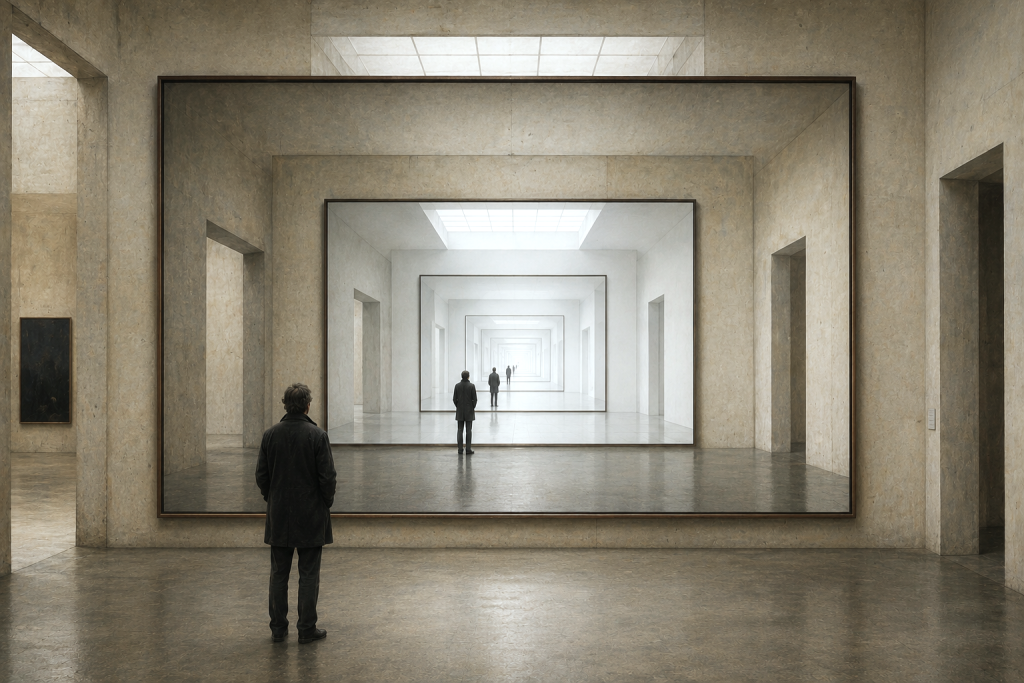
Something is wrong with the world, and you cannot point to it.
The coffee shop has exposed brick and Edison bulbs and a chalkboard menu written in a font designed to look handwritten. The playlist was chosen by an algorithm trained to sound like a person who loves vinyl. The barista’s tattoos are real. Everything else in the room was designed to convince you they might not be.
You order a latte and the foam has a leaf pattern stamped into it by a machine. You sit at a reclaimed wood table manufactured last year to look one hundred years old. You open your phone and scroll past a photo of a sunset that has been color graded to look more like a sunset than the sunset did. Somewhere behind all of it, you feel a small, persistent flatness, the sense that you are moving through a very good simulation of a place rather than the place itself.
Nothing here is a lie, exactly. The coffee is real coffee. The wood is real wood. And yet you leave feeling slightly less present than when you arrived, as if you had visited a museum of your own life.
This feeling has a casual name now. People call it fake, curated, staged, performative. But naming a feeling is not the same as understanding it. Ask someone why the coffee shop feels fake and they will gesture vaguely at capitalism, or Instagram, or late stage something. These are not wrong. They are also not answers. They are the finger pointing at the moon.
Here is the actual mystery, stated plainly. We live in the most objectively verifiable, evidence rich, historically documented era in human history, and yet we walk through our days with the nagging sensation that we are being shown a performance rather than living a life.
Why would abundance of the real produce a feeling of the fake?
Start with something smaller, almost embarrassing to admit. Have you noticed that a photo taken on a nice camera can look less convincing than one taken on a phone? A wedding photographer captures a genuinely happy couple in perfect light with a shallow depth of field, and the image reads, instantly, as staged. A blurry, poorly lit phone photo of the same couple, taken mid laugh by a friend, reads as real. The information content of the good photo is higher. The trust it generates is lower.
We do not judge reality by how accurate it is. We judge it by how much it cost someone to make.
A Japanese roboticist named Masahiro Mori noticed a version of this decades ago while studying how people respond to humanlike robots. As a robot’s face grew more human, affection for it rose, but only up to a point. Just before the face became fully convincing, warmth collapsed into unease. He called the dip the uncanny valley. It was never really about robots. A real face carries thousands of tiny, unscripted asymmetries that come from actually feeling something. A manufactured face smooths them all away in pursuit of perfection. Perfection is the tell, because perfection is cheap and feeling is not.
Once you see this, you cannot stop seeing it. The coffee shop feels fake not because the wood is fake but because every visible imperfection in it was placed there on purpose. A real hundred year old table has scars from a hundred years of accidents. A manufactured one has scars from a single afternoon of a machine simulating a hundred years of accidents. Some old, animal part of your perception can tell the difference even when you cannot say how, because it is not reading the scars. It is reading what they cost to make.
The philosopher Jean Baudrillard once argued that a culture reaches a point where its copies stop referring back to any original and start referring only to each other. Disneyland, he wrote, is not there to fool anyone into thinking it is real. It exists to make the rest of America feel real by comparison. Think about how a modern candid photo gets made. Someone poses. They are told to look natural. They adjust until the naturalness looks convincing. What gets posted is not a captured moment. It is a manufactured index of what a captured moment would look like, built by people who know exactly which features to copy and none of the risk that once produced them.
We did not lose the real. We lost the assumption that appearances point back to it.
This changes what the flatness actually is. It is not sadness about one fake thing. It is the slow erosion of a habit the mind relied on without noticing: the habit of trusting that what you see is downstream of what happened. Remove that assumption gradually enough, across enough of daily life, and the mind does not panic. It simply stops fully arriving anywhere. You are present in the coffee shop and also, quietly, elsewhere, running a background check on your own experience that never resolves and never announces itself either.
Trust is not free. Every time you extend it and it turns out to be warranted, some part of your nervous system relaxes. Every time you extend it and it turns out to have been manufactured, that part tightens and does not fully release again. Multiply this by ten thousand small transactions a year, curated photos, algorithmic recommendations, a landlord’s testimonial that might be paid for, and you get a generation that did not become cynical by choice. It became cynical by attrition. The flatness is not apathy. It is a nervous system that has run out of places to safely put its trust down.
None of this means polish is guilt. A surgeon wants precise instruments. A pilot wants measurable tolerances. Optimization is not a moral failure, and a well made thing is not automatically a dishonest one. The trouble starts only when we mistake polish for proof, when the smoothness that once accompanied sincerity gets treated as sincerity itself, long after the two have quietly come apart.
The line between real and fake was never about materials. It was always about whether intention had left a visible cost behind. A handwritten letter and a beautifully typed one can both be completely sincere. What made the letter feel real was never the ink. It was the sense that the person on the other end had spent something: time, risk, unguarded attention, to produce it. What makes the modern world feel fake is not its surfaces. It is the growing suspicion that nothing costs anyone anything anymore, that every smooth surface was optimized rather than earned.
Humans do not trust perfection. They trust cost.
That single sentence explains the coffee shop and the photograph and the robot face all at once, and it explains where this is heading next. Language models can now produce a personal-seeming message in half a second. Image generators can produce a candid-seeming photograph, stray hair and awkward smile included, in three seconds, tuned exactly to read as unstaged. The imperfection that used to be proof of friction is becoming a checkbox. This is not a future problem. It is already the texture of an ordinary afternoon online. Within a small number of years, most of the text, image, and voice an average person encounters daily will not have required real human cost to produce, and instincts built over millennia to treat blemish as proof of effort will be running on a signal that has been fully decoupled from what it once meant.
This will not announce itself as a crisis. Most of the time it will feel exactly like the coffee shop. Pleasant. Slightly hollow. Impossible to point to.
If the old signal, imperfection, has been captured, a new one has to take its place, because humans will not stop needing a way to know when something actually cost another person something. That signal is likely to become a different kind of scarcity: not the scarcity of polish, which once indicated care, but the scarcity of time given without an audience. A message written for one person, that no one else will ever see, that will never be shared, that gains its sender nothing measurable, may become the new handwriting. Not because it looks different. Because faking it requires knowing there is no one watching to reward the effort, and that is a much harder thing to fake than a blemish.
The deepest form of realness left available to us may not be a texture at all. It may be a transaction with no observer, offered anyway.
Think about the last time someone did something for you that they had no reason to let you know about, and told you only after you asked. Think about how different that felt from the curated candidness of a feed. That difference is not nostalgia. It is data. It is the last uncounterfeited signal standing, for now, and it will not stay uncounterfeited forever, because nothing that becomes valuable stays unclaimed for long.
The coffee shop is not really the problem. It is a small, harmless rehearsal of a much larger reorganization happening underneath ordinary life, a slow renegotiation of what counts as proof that another mind was actually present with you, actually spent something on you, actually meant it.
You will walk into another version of that coffee shop tomorrow. Something in you will scan the room without being asked to. Let it. That quiet, involuntary check is not paranoia. It is the oldest instrument you own, recalibrating for a world it was never built to read, asking one plain question underneath everything else it notices: what, here, actually cost someone something.
Before You Leave
The ideas in this essay didn’t begin here.
They first appeared, in fictional form, inside my novel The Signals You Ignore.
I’ve made the opening chapters available free.
If you enjoy essays that explain ordinary experiences in unexpected ways, consider subscribing.
New essays explore the hidden structures beneath modern life, technology, institutions, psychology, and culture.
Subscribe for free